HEALTH & DEVELOPMENT
Socio-economic situation and Determinants of Health
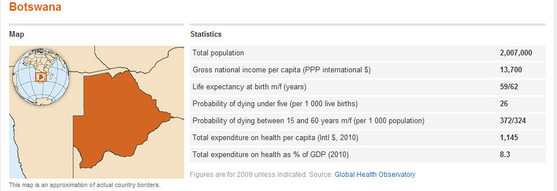
The stable democratic governance coupled with the natural endowment with mineral resources is facilitating very high rates of economic growth in Botswana, which is classified as a middle-income country. In the period 1999/2000 and 2004/2005, the total GDP grew at an annual rate of 8%.
However poverty rates are fairly high for a country of Botswana’s income level and income inequality is also high. Nationally, 23.4% of the total population lives on less than a dollar a day. The percentage ranges from 5.1% of cities/towns, to 19.3% of the urban villages and as high as 36.1% of the rural populations.
Improved sanitation coverage is 60% in the urban and 30% in the rural areas. Vulnerable populations in Botswana include people with disabilities and orphans; the latter increasing rapidly as a result of HIV and AIDS. However, Government programmes to support orphans and those caring for them appear to have been effective at reducing, although not eliminating their vulnerability to poverty and abuse. More generally, opportunities for the youth are limited once they leave school, resulting in twin problems of youth unemployment and rising crime rates.
Access and quality of health services
In addition to an extensive network of 101 clinics with beds, 171 clinics without beds, 338 health posts and 844 mobile stops PHC services in Botswana are integrated within overall hospital services, being provided in the outpatient sections of Primary, District and Referral hospitals. These facilities should be enough to provide optimal services for the population however factors affecting access and quality include unequal distribution of health facilities per population, low ‘after hour’ services, and variable utilization of services (bed-occupancy, length of stay for in-patients etc). In addition the commodity supply chain has also been problematic and stock outs of various commodities have been experienced. There is a need to establish set norms for distribution of PHC and hospital facilities and their use per population. This will be done within the context the comprehensive integrated services delivery plan that is currently under development. The availability and management of staff, mix of skills, equipments, medical supplies and the referral system are among the other issues that need to be addressed to improve access and quality of services.
Human resources
Shortages of Human Resources for Health remains one of the major “bottle necks” in health improvement as it is a cross-cutting issue that influences the delivery of services. Despite government’s efforts in increasing the capacities of health training institutions, human resources for health have been in short supply largely to work conditions of health staff, attrition is thought to be high (precise data on the rate of national attrition is not available) and some de-motivating factors affecting skilled staff. The Government has begun to address these issues. There are also increasing demands on the already over-stretched skilled work force due to HIV/AIDS. A long term Master Plan for Human Resources for Health has been finalized. Efforts will now be directed towards the implementation of the Plan in a sustainable manner by the full participation of all relevant stakeholders.
Health Management Information Systems
The paucity of relevant health information necessary for planning, timely interventions and monitoring and evaluation remain a big challenge in the Health Sector. Progress has been made in some programmes, particularly HIV/AIDS, but generally there is low articulation and use of data, which results in inadequate evidence-based planning monitoring and evaluation. In addition there are inconsistencies in the health information, particularly related to the main indicators, reported by different programmes and partners, including the UN agencies. Generally there is shortage of skilled staff in data management in all sectors and low capacity in the Health Statistics Unit. The partnerships in health development and the current momentum for scaling up of interventions towards achieving the set targets of the health related MDGs provides good opportunities for improving health management information systems
Major Disease Problems
Health in general and HIV/AIDS in particular are exerting a considerable impact on the social and economic fronts of live in Botswana. This is due to the disease burden and its impact in terms of costs for management of the diseases problems as well as the impact on overall wellbeing of the people. In addition, there are emerging health problems such as drug resistance TB and noncommunicable diseases that will continue to strain the health care delivery system. Threats of emerging diseases of international importance such as pandemic influenza and climatic change related health impacts require further strengthening of the capacity of health services for timely response and containment.
A number of malaria control interventions have been implemented over the years however challenges still remain in achieving the coverage targets for pregnant women and children under five. Botswana’s aim is to move from malaria control to elimination by 2015. Therefore the focus in the coming years should be on development and mplementation of a comprehensive malaria elimination strategy.
Maternal mortality related to complications of child birth and cervical cancer is quite high.
In addition, there are gaps in terms of reaching all children with the child health services, including malnutrition contributing to child mortality. The focus in the coming years will be to implement the road-map for Reduction of Maternal and Newborn Mortality and move towards attainment of MDG 5; and strengthen the implementation of reaching every child (RED) with immunization and IMCI services.
Another key observation is that in recent years there has been a steady increase in non-communicable diseases, namely, hypertension, cancers and diabetes. Oral health, mental health, injuries and disabilities are also becoming problems. The major challenge is to get a clear understanding of the magnitude and types of these diseases and to begin to systematically address them at national and community levels as priority areas in the national health agenda.
Of particular concern is the still large number of new HIV infection which if not effectively addressed will continue to undermine all the gains made through HAART, PMTCT, and other programs. The critical focus in HIV/AIDS will be the implementation of a comprehensive HIV prevention strategy that addresses all the key drivers of the epidemic including the associated socio-economic and gender factors.
There is a steady increase of noncommunicable diseases, namely, hypertension, cancers and diabetes in Botswana. Oral health, mental health, injuries and disabilities are also problems in Botswana. The major challenge for the Government is to get a clear understanding of magnitude and types of these diseases and to begin to systematically address them at national and community levels as priority areas in the national health agenda.