SWAATC.COM

SWAATC - Republic of Zambia

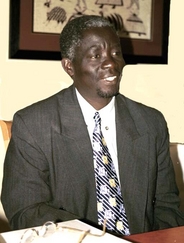
Dr. Kenneth Chandra - " In- Country Coordinator"

Dr. Kenneth Chanda - President Zambia Telehealth Project & Republic of Zambia :
National Telehealth/ Telemedicine Steering Committee Coordinator:

The major objective of the Zambia Telehealth Project is to create centers of excellence across the Republic of  Zambia and to share the vision of the Africa Telehealth Project. Dr Oryema Johnson was and is the Africa Telehealth Health Project Director. Therefore from that time to date Zambia Telehealth Project has recruited a number of medical doctors, nurses, health information scientists, Information Technologists, medical librarians, radiographers from Lusaka and Copperbelt.
 
The Project desires to compliment the efforts of the Ministry of Health and the Central Board of Zambia in the provision of health care services in Zambia with special emphasis on eConsultation and distance learning. It is against this background that the Zambia Telehealth tries to use the existing infrastructure such as health centers, colleges and universities.


The Zambian chapter as a "Strategic Alliance Partner" with the Safe Water Access and Training Consultants will use a number of portals to expand telehealth activities and telemedafrica moderated by Dr Henry Edington and EMG--Africa who will be spearheading spearheading the direction as indicated below.


TELEMEDICINE FOR HEALTH WORKER TRAINING AND RURAL AND URBAN MEDICAL CONSULTATION IN ZAMBIA, SADC, AND COMESA COUNTRIES


In countries where distances between health workers and vast, transport is inefficient or not available, health care providers are few and workload on them are high. Telemedicine can serve to bridge the distance gap. Transport inefficiency and time shortage for meetings and consultations. In Zambia, Telemedicine services will certainly benefit both Patients and health workers. A project, which has been under development for the past 20 years, is due to yield the above fruits of Telemedicine in 3 steps.

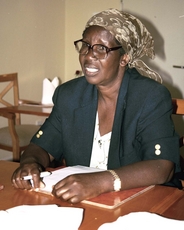
Ms. Agnes Simasiku - President - The Women's Clubs Association of Zambia


As the thepresident of the Women's Club Association of Zambia, it is our commitment and the desire of the full membership to work with Safe Water Access and Training Consultants in  the development and deployment of a program geared to the –“Strengthening of Mother Child Health/ Reproductive Health Services across the and Zambian Health Systems “ by implementing a safe water access training and delivery program.
 
The partnerships and alliances that you have developed with EMG-Africa, the World Health Organization Family and Community Health Cluster, the Zambia Defence Force Medical Services, the Civil Military Alliance, the University of Pennsylvania's Center For AIDS Research, New Jersey AIDS Education and Training Center and the New Jersey AIDS Coalition is very exciting. 
  
Safe Water Access and Training Consultants  is to be commended for the development and deployment of an internationally recognized safe water program. The manner in which the content was developed to reflect cultural sensitivities demonstrates your expertise and understanding of how a program must be developed if it is to be successful. 

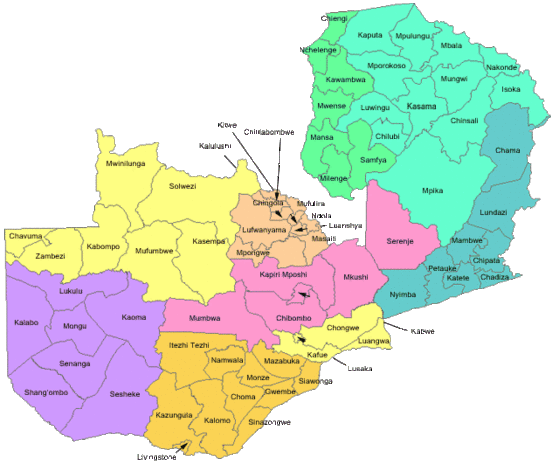
The Women's Clubs Association of Zambia has in excess of 1,500 members across the 9 Provinces and 72 Districts in the Republic of Zambia, who are all prepared and willing to offer their support as active volunteers.  As the presidernt of the Women's Clubs Association of Zambia, we would be happy to help you in any way possible as you are developing your proposal and deploying this life-saving  program
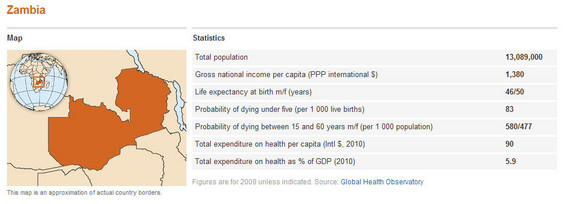
Zambia is a landlocked country, covering an area of 752,612 square kilometres. It has a population estimated at 12.9 million in 2009 and an annual growth rate of 2.9% per annum divided almost equally between males and females (CSO Projection, 2003). The total fertility rate is high at 6.2 (ZDHS, 2007). It has a high a high dependency ration with 47% of the total population under the age of 15 years.
 
Thirty eight percent of the population lived in urban areas in 2006, which makes Zambia one of the most urbanized countries in the region. The system of Government is multiparty democracy and a market oriented economy.


HEALTH & DEVELOPMENT

 The huge burden of preventable and treatable disease continues to contribute to high morbidity and mortality, thereby negatively affecting socio-economic development. Health indicators have generally not improved since 1980. For example, life expectancy at birth in 1980 was 50.4 years for males and 52.5 years for females; in 1996, it was 46.2 years for males and 44.7 years for females, in 2007, it was 45 years for males and 47 years for females Due to the past poor macroeconomic performance, health services remain under-funded. World Health
 
Organization Commission on Macro-economics has estimated that a country such as Zambia needs a per capita expenditure on health of US $33 in order to deliver the Basic Health Care Package. In 2000, the total per capita expenditure on health, from GRZ and Cooperating Partners (CPs), was estimated at $10.8 and was projected to increase to $12.0 by 2005. The actual per capita expenditure during the period 2001 to 2004 has however only averaged $10.5.
 
The Government has made a commitment to progressively increase annual funding for the health sector from the current 11.5% of the budget to 15%. The change in the method of funding from basket funding to direct support means that cooperating partners direct their support towards the Ministry of Finance rather than directly to the Ministry of Health as was the case before. This has implications in that the release of funds from the Ministry of Finance and National Planning to MOH is usually delayed. This has been worsened by the abolition of user fees in rural health facilities which has contributed to a reduced total funding of health services.
 
The Central Statistics Office (CSO), 2004 Living Conditions Monitoring Survey Report showed that 68% of the population was below the poverty line. Most of this poverty was attributed to the inability to acquire food. However, Zambia has a great opportunity to expand and improve her economy and reduce poverty as the external reserves are expected to rise modestly. The improvement in external reserves and the implementation of the HIPC initiative have led to an increase in funding to Government sectors.
Safe Water Access and Training Consultants Project Summary

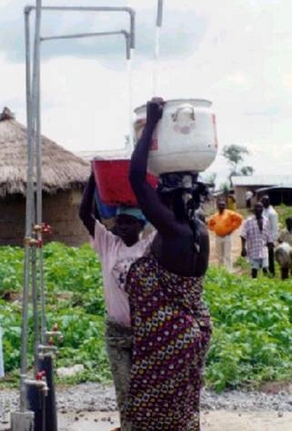
The 5-Year Potable Water Delivery and Training Program for the Republic of Zambia is a joint  effort comprised of strategic public and private alliance partners to support the objective of reducing  the needless deaths and illnesses associated with the lack of access to Safe drinking water.


The Partners are as follows:

 
• Ministry of Health
• Central Statistical Office
• Tropical Disease and Research Center
• Women’s Clubs Association of Zambia
• University of the Republic of Zambia School of Nursing
• Center for Disease Control (CDC)
• World Health Organization
• ResourceLinC
• EMG-Africa
• SecureState, LLC
 

The goal of this team is to come together to develop a  comprehensive, robust and effective safe water system and training program solution for the people of Zambia regardless of their physical location by utilizing the added values of GIS and ICT


In order to ensure countrywide coverage for the safe water training and implementation, there will be 2 Edu-TeleCenters in each of the 9 Provinces, which will be co-located with an identified Ministry of Health Provincial Hospital. 


The Districts located in the Province will be equally divided and assigned to  either of the Edu-TeleCenters for safe water support, training and medical assistance.


This medical assistance and training Will be provided using the resources and expertise of EMG-Africa, our  medical, informatics, information and communication Technology partner.