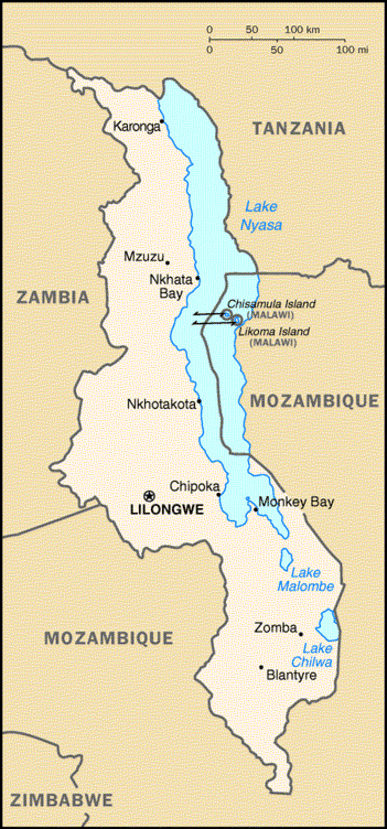
Malawi is a low income country in Southern Africa characterized by a heavy burden of disease evidenced by high levels of child and adulthood mortality rates and high prevalence of diseases such as tuberculosis, malaria, HIV/AIDS and other tropical diseases. Healthy Life Expectancy (HALE) at birth was 44 years in 2007.
Furthermore, evidence suggests that there is a growing burden of non-communicable diseases. The economy relies on agriculture and is highly vulnerable to climatic conditions. The population density is one of the highest in Sub-Saharan Africa.
HEALTH & DEVELOPMENT
Economic activity
– Agriculture is the mainstay of the economy, accounting for about 36% of the GDP
and more than 70% of exports. GDP per capita registered an average annual growth rate of 1.2% during the period 2000-2005. Economic growth has been spurred by the recent significant rebound in the agricultural sector. An impressive real GDP per capita growth rates will be required to reduce the levels of poverty.
Poverty in Malawi
– the incidence of poverty is higher in rural areas; the Southern region of the country; among female-headed households; and households whose head has no formal education. The country faces a number of challenges in its endeavours to eradicate extreme poverty including inadequate finances to support poverty reduction programmes; high levels of illiteracy; and critical shortage of capacity in institutions implementing development programmes.
Investment in health
–the per capita expenditure on health stands at US$ 25 (NHA, 2005/6).
Development partners contribute about 60% of the total expenditure on health. Prepayment schemes contribute to less than 3% of the health spending. Most of the contribution from private sources is obtained from households in the form of out-of-pocket expenditure. The health care delivery system consists of government facilities, Christian Health Association of Malawi (CHAM) and some private-forprofit
providers.
Malawi human resources for health
- there are only 2 physicians and 38 nurses per 100,000 population. In 2010, vacancy rate for nurses at national level stood at 74%. The government in conjunction with its development partners implemented a 5-pronged 6-year Emergency Human Resources Plan from 2005-
2010 which included a 52% salary top up to 11 cadres of health professionals. This resulted in a 50% increase in health work force and enrolment in training institutions. The challenge is to sustain and improve the gains so far made.
HIV/AIDS prevalence is very high
- The 2004 Demographic and Health Survey indicates that 12% of the population aged 15-49 years in Malawi is living with HIV/AIDS. The observed and adjusted HIV prevalence among women and men aged 15-49 years were 11.8% and 12.7% respectively. Estimated prevelance was 17.1% in urban and 10.8% in rural areas. Approximately 80 000 people die of AIDS annually and an almost equal number of new infections occur yearly. There are approximately 600 000 orphans in Malawi due to HIV/AIDS. Substantial progress has been made in the provision of antiretroviral therapy (ART). By the end of 2010, an estimated 250,000 people had been ever started on ART
representing 52 % of those in need.
Tuberculosis prevalence
– the prevalence of tuberculosis has decreased from 344 in 2005 to 269 in 2009.
The HIV/AIDS prevalence in incident TB cases has declined from 77% in 2000 to 64% in 2010.
Malaria.
It is the most common reported cause of morbidity and mortality – malaria is responsible for about 40% of hospitalization of under-five children and 40% of all hospital deaths. Treatment policy change to Artemisinin-based Combination Therapy (ACT) was effected in 2007 however the diagnosis still remains clinical with presumptive treatment.
Non-communicable diseases (NCD)
– are on the increase. It is estimated that 33% of adults aged 25-64 have hypertension and 5.6% are diabetic. About 5,000 new cases of cancer are registered annually. The commonest cancers are Kaposi sarcoma 34.1%, cervix 25.4% and Oesophagus 12%. The major risk factors
for NCD include tobacco smoking in males (29.5%) harmful use of alcohol and high HIV prevalence. The country has established a national NCD control programme.
Neglected tropical diseases (NTD) -
The common Neglected tropical diseases are schistosomiasis, Lymphatic filariasis, onchocerciasis and trypanosomiasis. The country is responding through mass drug administration for prevention and control.
Infant and under-five mortality rates have declined
– Infant mortality rate declined from 134 per 1,000 live births in 1992 to 66 in 2010. Similarly the under-five mortality rate decreased from 234 per 1,000 live births in 1992 to 112 in 2010. However, neonatal mortality rate has increased from 27 per 1,000 live births in 2004 to 31 in 2010. The trend in under-five mortality is showing that the country is on course for achieving MDG 4. There is a high prevalence of malnutrition among children under-five – Despite reduction of 5% (46% in 2006 - 41% in 2010), the stunting rate is still very high. Underweight also declined from 20% in 2006 to 17% in 2010. About 64% of children aged 6-59 months are aneamic.
Maternal mortality is still among the highest in Africa
. Based on the 2010 EmONC assessment, 65% of women in Malawi are delivered by skilled workers. Only 2% of all the BEmONC sites and about 48% of the CEmONC sites are fully functional. Obstetric complications contribute significantly to maternal deaths and bleeding alone accounts for 40% of all deaths. Other indirect causes include delays in seeking care, poor referral system, and lack of appropriate drugs, equipment and staff capacity. The assessment also revealed that not much progress has been made in making the services accessible to hard to reach areas The findings of the EmONC assessment have informed the revision of the roadmap to accelerate reduction of maternal mortality